
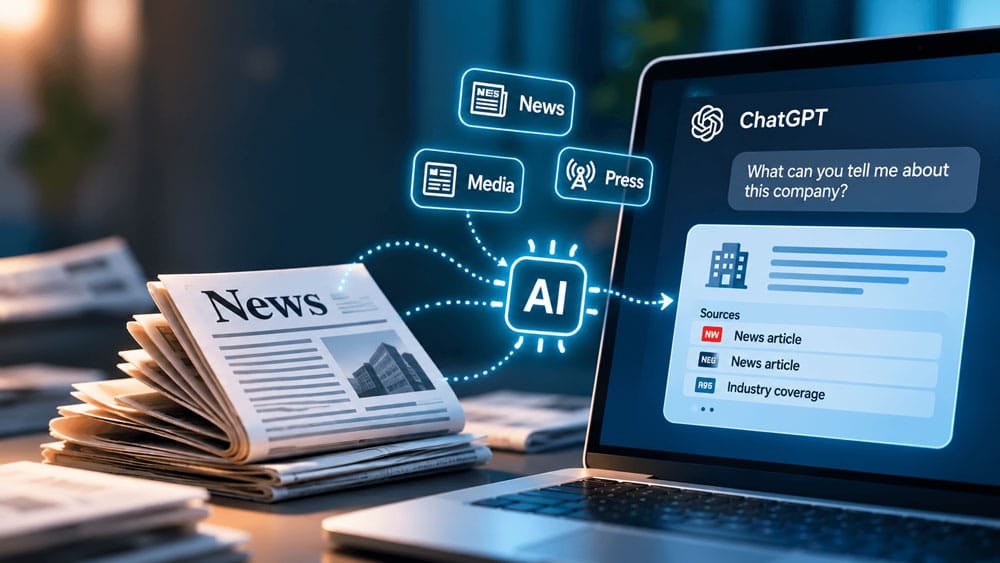
AI cites news media more than twice as often as your own website. When customers ask ChatGPT or Gemini about your company, the answer is built from what journalists have written about you. Earned media is now the source of what AI says about your brand. If you are not in the news, you are not in the answer.
Ask ChatGPT, Gemini or Copilot about a company today and you get a short, confident answer. That answer is not written by the company. It is assembled from what others have published about it, and editorial coverage carries the most weight.
This changes how we should value media relations. As Omnicom’s Shouvik Prasanna Mukherjee told Marketing-Interactive, earned media is becoming “the primary fuel for how AI systems describe a brand.” A news article no longer only reaches its readers. It also becomes source material for every AI answer that mentions your name.
What the research shows
Several studies over the past year point in the same direction: AI platforms lean on independent, third-party sources far more than on what brands publish themselves.
- Muck Rack analysed more than 25 million links cited by ChatGPT, Claude and Gemini. In its May 2026 edition, 84% of citations came from earned media, and 27% from journalism specifically. Paid content accounted for 0.3%.
- Stacker compared stories placed with third-party publishers against the same content on brand websites only. The placed stories received a median of 239% more AI citations, and 97% were cited at least once, against 82% for owned content.
- Connective3 looked at 3,500 links and found that prominent, meaningful brand mentions in coverage were more likely to carry through into AI summaries than passing mentions.
Two caveats are worth keeping in mind. Muck Rack’s “earned” category is broad and includes sources beyond journalism, so 84% is not the share driven by media relations alone. And most of these studies come from companies that sell PR or distribution services. The direction is consistent, but the exact figures are not interchangeable.
Editorial coverage versus brand websites
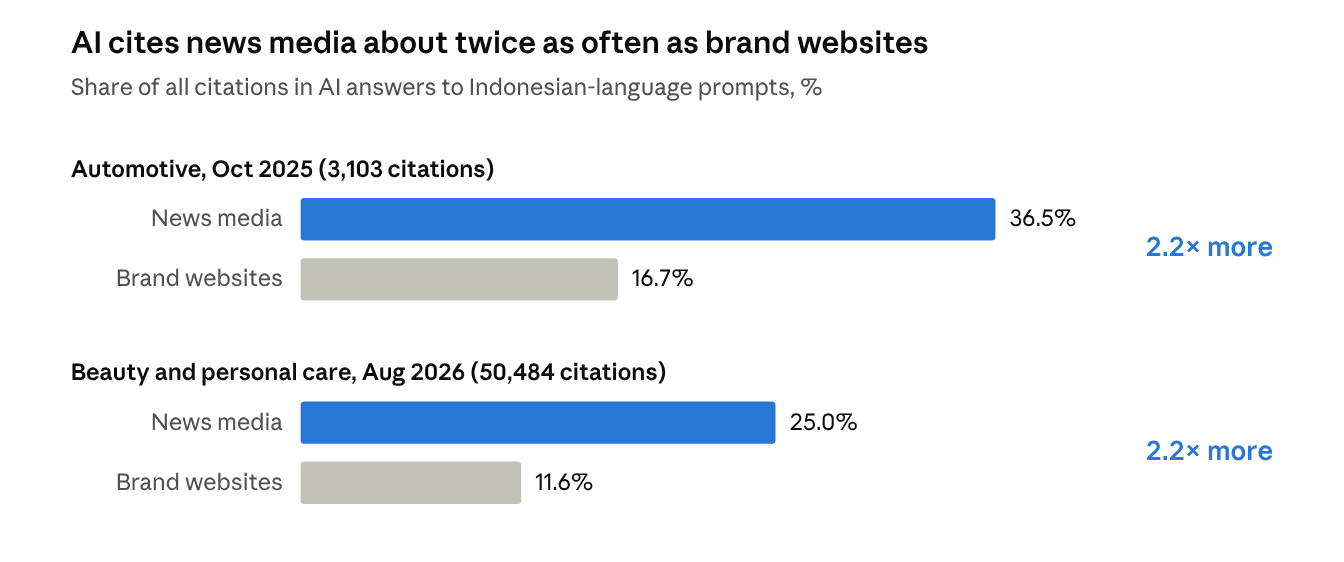
Maverick Indonesia AI visibility studies: automotive, Oct 2025 (300 answers, 6 platforms); beauty and personal care, general prompts, Aug 2026 (6,400 answers, 5 platforms)
Two Indonesian industries, two separate studies, the same ratio: independent news coverage is cited more than twice as often as the brand’s own website.
The same pattern in Indonesia
Two studies by Maverick Indonesia test this in the local market, with prompts written in Bahasa Indonesia.
In the automotive study (October 2025), 300 answers from six AI platforms produced 3,103 citations. News outlets such as Kompas, GridOto, Detik and Suara were the largest single group of sources. Kompas and GridOto alone accounted for 18% of all earned media citations, but more than half came from outside the top ten publishers. Smaller titles count too.
In the beauty and personal care study (August 2026), 6,400 answers to general questions produced 50,484 citations. News media were the most cited category, ahead of health and medical sites (21.6%) and well ahead of brand websites. Suara.com, a general news site, was cited more often than Beautynesia, Female Daily and Popbela combined. Coverage in general news reaches further into AI answers than many beauty brands would expect.
The studies also show that platforms differ. In the beauty study, news media made up 53.1% of Copilot’s citations but only 9.5% of Google AI Overview’s. And recency matters: about half of automotive citations, and 61% of beauty citations, came from content published in the previous six to twelve months. Coverage needs to be continuous, not occasional.
Where social media fits
Social media also feeds AI answers, but it plays a different role. News coverage tells AI what a company is and whether it can be trusted. Social platforms add experience, opinion and expert commentary.
Meltwater’s August 2026 report tracked about 7.3 million citations across eight AI platforms in seven consumer categories. Social platforms supplied 7.2% of citations, against 29.4% for earned and news media. YouTube, Reddit and LinkedIn were the most cited social sites.
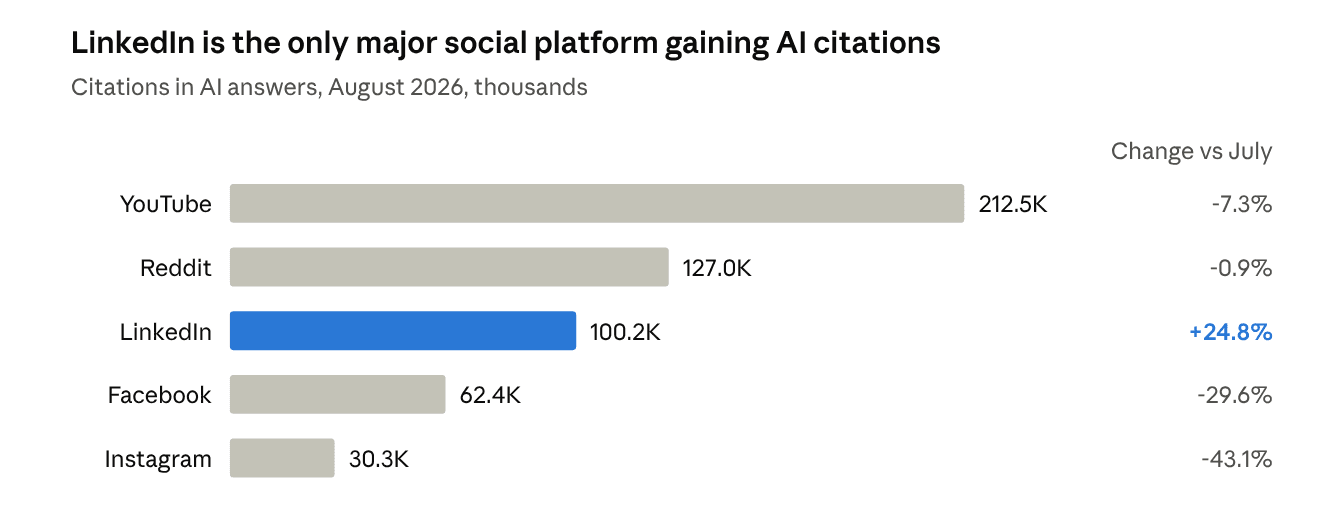
Meltwater AI Search Visibility Report, August 2026: about 7.3 million citations across 8 AI platforms, 7 consumer categories, prompts without brand names
How much social media counts depends on which AI platform your audience uses:
- ChatGPT cited none of the five largest social platforms in Meltwater’s August data.
- Google AI Mode cited LinkedIn in nearly 15% of answers in a Semrush study of 230,000 prompts. YouTube and Reddit were also among its top sources.
- Perplexity cited LinkedIn more than any other social platform in August, followed by Reddit and YouTube.
- In Indonesia, social content made up 28.1% of Google AI Overview’s citations in the beauty study, but only 1.8% of Copilot’s.
Social citations also move quickly. Semrush found that Reddit appeared in close to 60% of ChatGPT answers in early August 2025, and in about 10% six weeks later. Journalism has been steadier: Muck Rack reports that it has held at 25–27% of AI citations since July 2025.
LinkedIn and the B2B buyer
For B2B companies, LinkedIn stands out. A Meltwater study with LinkedIn, based on 9.5 million AI citations from B2B prompts, ranked LinkedIn as the second most cited domain after YouTube. Its share grew 26% during the four-week study. In that dataset, user-generated platforms together accounted for 47.5% of citations, against 18.7% for company websites. Social plays a larger role in B2B questions than in the consumer categories above.
The study also shows what gets cited:
- About 75% of LinkedIn citations came from individual profiles and 25% from company pages. What your executives and experts post counts.
- 51% of cited creators had fewer than 10,000 followers. Relevance matters more than reach.
- 72% of cited content was text posts, and 72% was original rather than reshared. Almost half had been published in the previous three months.
- Cited articles were structured. All used lists, most used headings, and two thirds included hard numbers.
Working together
In the Indonesian beauty study, social content became more prominent when people asked about a specific brand. AI then looks for reviews, creator content and personal experience. For general questions about which brand or product to choose, it leans on news and health sources.
Social media and earned media therefore work together. Coverage establishes the facts and the credibility. Social posts, especially from named experts on LinkedIn, extend that coverage, add a human voice and reach the AI platforms that favor them. A company present in both has more ways into the answer.
What this means for communications teams
Earned media has always built trust with people. It now also shapes what AI says to them, often before they ever visit your website. A few practical points follow:
- Value coverage for its afterlife. An article keeps working long after publication, each time an AI platform draws on it. Quality and prominence of the mention matter more than volume.
- Think beyond your usual titles. General news sites, trade media and smaller publishers all feed AI answers. A broad media footprint pays off, and LinkedIn posts by your own experts extend it.
- Keep the story current. AI favors recent content. A steady flow of news and commentary does more than a single campaign.
- Keep owned content consistent. AI checks facts against brand websites. What you publish should match what the media reports.
- Know what is being said. You cannot influence AI answers without knowing which articles mention you, where, and in what tone.
That last point is where media monitoring comes in. Tracking your coverage, and your competitors’, shows you the raw material AI is working with. It tells you where you are visible, where you are missing, and which stories need a response.
At NewsMachine we monitor news and online media across Indonesia and Southeast Asia. If you would like to see what the media, and therefore AI, is saying about your company, we are happy to show you.
Sources
- Indonesia’s PR industry is bridging the generational divide in the age of AI — Marketing-Interactive
- Generative Pulse: Earned Media Consistently Drives AI Citations, Holding at 84% — Muck Rack, May 2026
- Muck Rack Study: Generative AI Relies Heavily on Earned Media and Journalism — Muck Rack, July 2025
- Stacker Research: Earned Media Triples AI Search Visibility — Stacker, March 2026
- Digital PR and AI Visibility: What 3,500 Links Tell Us — Connective3
- What Does “Earned” Mean in the Age of AI? — PR Daily
- AI Search Visibility Report: August 2026 — Meltwater, September 2026
- How LinkedIn Content Wins AI Search — Meltwater and LinkedIn, May 2026
- The Most-Cited Domains in AI: A 3-Month Study — Semrush, November 2025
- AI Visibility of the Indonesian Automotive Industry 2025 — Maverick Indonesia, October 2025
- Beauty in the Eyes of AI — Maverick Indonesia, August 2026